


Safety PAL is a unique Health and Safety Management System built from a requirement to ensure people are safe and healthy while at work. Our unique approach also helps companies meet their legal requirements regarding health, safety and wellbeing.
We always enjoy posting guest blogs, helping all our followers improve their personal health and safety.
This article has been written by a returning writer with a passion to help everyone understand the importance of better manage working at home and their health.
We hope you enjoy reading this article as much as we did when we first read it.
Stretch Your Way to Work-From-Home Bliss
As part of concerted global efforts to curtail the spread of COVID-19, many businesses have had to either temporarily or permanently close their physical locations. And in order to stay employed or find new jobs, many displaced workers have had to quickly adapt to work-from-home conditions. Unfortunately, this abrupt digital migration has also caused many to develop unhealthy work-from-home habits, leading to pain and stiffness in bodies not used to working alone at home.
Work-from-home jobs tend to involve more hours of just sitting in one spot compared to office environments. Office work typically involves moving from one location to the next for different tasks, going to meetings, or coordinating with coworkers. These natural standing and walking breaks to stationary working are often absent in work-from-home situations, as workers can fulfil their job description without having to leave their desks. As convenient as this sounds, it may also eventually wreak havoc on different parts of your body.
“The issue that we’re really up against is that we’re not made to sit—certainly not for extended periods of time,” details Stanford Health Care sports medicine physiatrist Michael Fredericson. “You tend to hunch forward, and your neck protrudes, and there’s eye strain. It’s stress that goes through your whole body.”
For addressing neck tension and stress, Fredericson recommends doing a basic forward-backward neck retraction exercise. Simply stand or sit upright as you slowly push your head and jut your chin forwards. Do this while maintaining a straight spine and a level head – and then do the reverse by recoiling your head back as far as it can comfortably stretch.
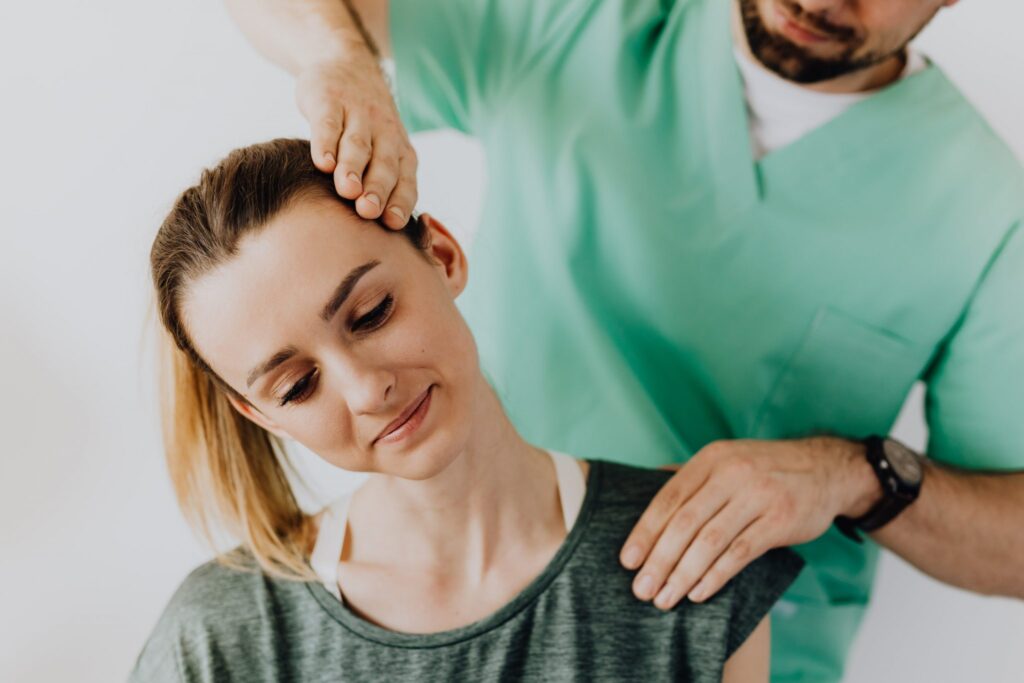
Meanwhile, if there’s tension in both your neck and shoulders, doing side tilt stretches can help. With your back straight and your arms loosely hanging at the sides, very carefully move your right ear towards your right shoulder until you feel a stretch on your neck’s left side. Hold this position for a couple of seconds. Mirror this movement with the left side of your head to stretch your neck’s right side.
If your neck still feels tense after these stretches, you may also need to stretch your cervical spine or even your entire back. As Pain-Free Working’s guide to neck stretching exercises explains, treating the entire system that supports this area is important to keeping it free of tension and discomfort. Likewise, by regularly doing exercises
to stretch and strengthen your neck, you can help prevent or alleviate pain and tension in your shoulders, arms, and upper back.
This underscores the role of physiological connections in addressing specific tension points through stretching. Whenever tension builds up or leaves one part of your body, another part that either connects or supports that said point will be similarly affected. These physiological connections are not always obvious, which is how mysterious pain and stiffness occur across the body. For instance, Pop Sugar’s guide to healthy morning stretches reveals that while sitting all day keeps your hamstrings contracted, this is more likely to cause tension in your lower back and lower legs than your hamstrings themselves. This is due to the complex mechanical connections of these lower parts of the body.

You can fix this lower body tension with the classic sit and reach. Start by sitting on the floor and extending your right leg, folding your left leg, and placing your left foot against your right leg’s inner thigh. Take a deep breath. Slowly exhale while reaching out with both hands to touch your right toes – or just your shin if that’s your limit. Try to hold this position until you can do ten full deep breaths, and then mirror the movements with the other side of your body.
These are just some of the basic ways to stretch your way to work-from-home bliss. Apart from these fundamental stretches, you should do your best to avoid unhealthy work-from-home habits like sitting without moving for prolonged periods of time. The more you stretch and actively break prolonged periods of stationary desk work, the less you need to worry about mysterious pains and stiffness in different parts of your body.
The article made only for the use of Safety PAL (PLAN ACT LEARN) yoursafetypal.com
By Amanda Smith
Don't take our word for it,
we'll show you how...
Keeps Employees Safe
By providing training, managing and feedback systems that can be evidenced in 27 languages.
Reduces Risk of Accidents
Provides proof, to reduce your exposure to prosecution.
Provides Real-Time Reporting 24/7
Showing what has been completed, and what important tasks need to be done next.