


I was very grateful to be asked to attend a mock trial by the Health and Safety Executive (HSE). It was a great opportunity to see the court’s process, the questioning, and the sentencing from the comfort of the juror seats – without all the anxiety, stress and fear of being in the dock!
But what really shocked me was how much is at stake if you attempt to mitigate a health and safety breach without essential evidence – which in this case resulted in a possible £130,000 fine, turning in to a £500,000 fine!
I was welcomed that morning by the HSE who guided me into the waiting area outside of the court, along with many others who were to make up members of the jury.
We were all ushered into the real courtroom, with both barristers in full court dress. We were asked to stand as the Judge entered and took his seat below the huge coat of arms of local government. I found all this very daunting – it made me very glad I wasn’t the one on trial!
The case was introduced by a senior HSE member, quickly explaining the trial was based on a real recent event, and our job as the jurors was to declare the Managing Director (not the company) guilty or not guilty.
The case in question was a construction incident where an excavator struck a cable which exploded and caused severe burns to the operating banksman – a breach of Section 2(1) of The Health and Safety at Work Act 1974 to which the company had previously pleaded guilty. But the HSE felt there was sufficient reason to also bring the Managing Director to court on grounds of neglect which is punishable under Section 37 of The Health and Safety at Work Act 1974.
The Incident and witness statements
The prosecuting barrister stood adjusting the lapels on his black silk gown, and called the first witness; ‘the banksmen’.
Reading from his statement, the banksman explained that the site manager and the excavator driver both told him the ground had been scanned for services and this was a simple dig to install some new services and to hurry as time is money. While standing close to the excavator’s bucket giving direction to the driver, the bucket retracted followed by a sudden a large explosion. The excavator bucket had caught a live HV cable. This resulted in the banksman receiving severe burn injuries, 2-week hospitalisation in the burns unit and had only just started his rehabilitation return to work after being off for 12 months.
The defendant’s barrister then stood up and began to question the banksman’s responsibilities and competence, for example ‘why were you stood so close?’ ‘Why didn’t you just…?, Was this not your responsibility?’
I was quite taken back by the punitive questioning directed at the injured person – the one who suffered these severe burns and a year of pain. It was far more powerful seeing it for myself than one reads or watches on TV.
The barristers continued with an onslaught of questions to the other witnesses’ in-turn; the excavator driver, the site manager, the visiting HSE inspector and lastly the Managing Director.
I wondered why the witnesses (other than the HSE Inspector) were allowed to pass the blame for something without proof. They had continually said “I thought he’d do it”, “he told me it was ok” and, “no one told me that.” it really was everyman for themselves – his word against mine. If I were in this situation, I would always want a cushion of proof.
The Company’s Sentencing
The defendant’s barrister was asked by the judge to explain the company mitigation with relevance to the Section 2(1) breach – this would be their last opportunity to lessen the fine for the company.
The barrister with laptop in hand, read from her pre-compiled assessment. The barrister set a “Medium” culpability as a fair assessment, as outlined in the Definitive Sentencing Guidelines, with a seriousness of harm risk, category 3. The organisation was defined as “Large” with a turnover in excess of 52million – and all fines are proportionate to turnover (not profit).
We explain more about the sentencing guidelines here, and you can see they would affect your business if something went wrong here.
All this meant that the fine would start at £300,000, but could range between £130,000 and £750,000 depending on mitigating circumstances. The image below details factors increasing seriousness and what can be done to reflect mitigation.
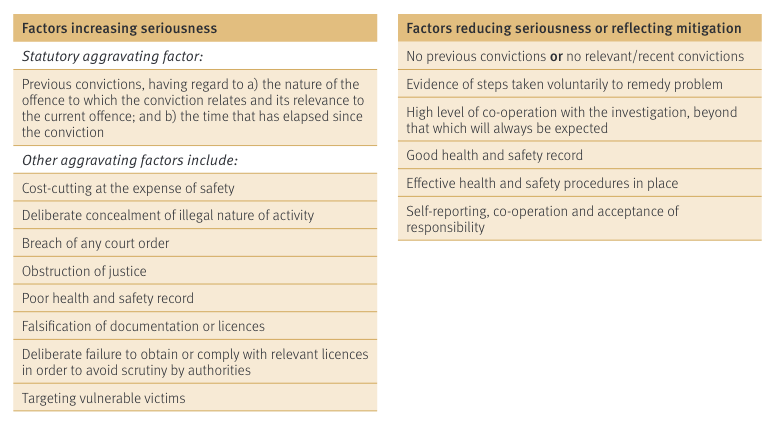
The defendant’s barrister pushed for the lowest possible fine of £130,000, explaining that the company gave full co-operation to the HSE investigation and also had a good health and safety record.
The judge took a few moments to review, and then looking up from his notes sternly, he addressed the defendant’s barrister; “I do not agree with your culpability assessment.”
The judge said that in his assessment the culpability was high, not medium. This one simple change from the judge suddenly increased this fine starting point from £300,000 to nearly double at £540,000!
After some further back and forth, the final applied fine was confirmed at £500,000, plus legal costs. Workers failed communication, cutting corners, assuming someone else had done it, fueled with poor methods and no sufficient evidence to prove otherwise all resulted in the £500,000 fine plus costs.
The Director’s personal prosecution
As this was a mock trial, the judge, skipped past Jury Deliberations and the Verdict, and ran us through both scenarios of being found guilty and not guilty.
If we found the Managing Director ‘Not guilty’ obviously there would be no fine, but there would still be the legal fees and costs.
If a ‘Guilty’ verdict was reached, then the Managing Director would face a personal fine of £50,000, plus costs.
In other cases, Managing Directors, as the person responsible, have been sent to prison from similar trials – over 50 immediate prison sentences were handed out in 2017/18 (HSE prosecutions link below). We’ve written about this previously in this article.
Frank discussions after the trial
The judge and barristers relaxed and opened the floor up for questions from us all who made up the jury. A couple of interesting points came up from the discussion…
Legal costs
When asked “How long does a case like this usually take?” The prosecuting barrister summed up that it would have taken just over a year, and would have been in excess of 100 billable hours. This would cost anywhere between £15,000 and £35,000 just for the barristers – with some senior advocates costing £60,000!
The burden of proof
The most poignant question asked was “What can we do as a company to ensure the result is ‘not guilty’?”
The legal team couldn’t give a definitive answer. Prevention was stated obviously, followed by good and robust standards.
Personally, I thought the answer to this question was very easy – ‘You need evidence’. The testimonies I had heard in the trial came down to ‘he said this’, ‘they said that’, ‘I think she did this’, etc. Statements like these, without solid proof to fall back on, are left entirely up to the whims of the jury – to interpret and eventually pass verdict on.
And I had just seen the results of a Managing Director and Company coming to court without adequate proof.
In summary
You can’t rely on witness testimony. If you haven’t properly documented your procedures, they’ll be of no help to you at all should the worst happen and you find yourself defending a health and safety breach.
You’ll need proof that:
• The workforce (including contractors) have read and understood appropriate Risk Assessments
• Site and Line managers have delivered inductions
• Workers are competent for the task, which includes more than just certificates and qualifications.
Implementing a safety management structure puts you in a much more secure place financially, with a great workforce that can go home safe at the end of each day, but also you’ll be much more in compliance with the law.
Useful links
Definitive Sentencing Guideline: www.sentencingcouncil.org.uk/wp-content/uploads/HS-offences-definitive-guideline-FINAL-web1.pdf
HSE Prosecutions Data (including the 50 directors immediate prison sentences): www.hse.gov.uk/Statistics/tables/prosecutions.xlsx
Section 2 of the HASWA: www.legislation.gov.uk/ukpga/1974/37/section/2
Section 37 of the HASWA: www.legislation.gov.uk/ukpga/1974/37/section/37
Don't take our word for it,
we'll show you how...
Keeps Employees Safe
By providing training, managing and feedback systems that can be evidenced in 27 languages.
Reduces Risk of Accidents
Provides proof, to reduce your exposure to prosecution.
Provides Real-Time Reporting 24/7
Showing what has been completed, and what important tasks need to be done next.