


Dealing with a Health and Safety incident or accident is something that nearly every business will need to manage just like any other business problem.
The problem
An incident or accident sends a shocking ripple through any business having a knock-on effect on other business sectors, their clients and even parts of their supply chain.
Fact; Businesses and Directors are prosecuted because they can’t prove they have done what is required of them by law, and not because an individual was injured.
Civil and Criminal Law
Please don’t think for a minute that an incident or accident only results in the Health and Safety Executive or Enforcing Authority building a case for the prosecution. Today it is increasingly popular for the injured or harmed person to make a civil claim against the company – if they believe you were responsible. This claim made by the individual and is separate from a health and safety breach under criminal law!
Employers’ Liability (compulsory insurance) is there if an employee was to try to claim compensation from you and ensures you have at least a minimum level of insurance cover against any such claim(s).
As the organisation duty holder (responsible person), the best security and protection you can create against a health and safety incident or accident is to mitigate, to prove you have done reasonably practicable in preventing harm, and to ultimately prove it was not the company at fault, but the worker or contractor that was negligent.
Mitigation and Evidence 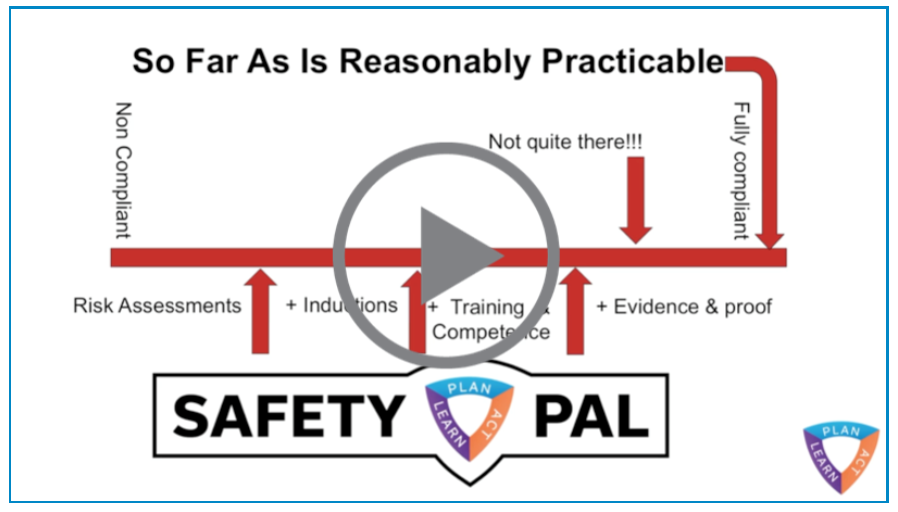
The most obvious, easiest and most proactive solution in creating this security and protection for you and your business, is to put in place robust standards and procedures which provide the proof needed and reduces the consequence of an accident.
This is the 21st Century, all businesses have access to a plethora of information, technology and resource to reduce the risk of harm – the struggle businesses have, is being able to deliver this information to the workforce with efficiency (not having to extend their management team) and proof.
No one goes to work wanting to hurt themselves, but still, even with all this information, technology and resource available, there are unfortunately workers’ who will injure themselves while at work. This may be due to a lapse in concentration or them simply trying to impress a boss or colleague or simply their incompetence.
It is for this reason, organisations of any size have a crucial requirement to reveal the proof of compliance to the Enforcing Authority or compensation claim solicitor. The evidence that the worker was indeed competent.
It is possible to protect from prosecution?
The reason companies are prosecuted and directors convicted is not because the person was injured (The level of injury is took into account under the ‘harm’ section of the ‘Health and Safety Offences, Corporate Manslaughter and Food Safety and Hygiene Offences Definitive Guideline’), but because the duty holder failed to provide suitable and sufficient evidence of compliance with the relevant Health and Safety Legislation.
But a lapse in concentration, impressing a boss or colleague or incompetence is hard to prove.
So the best way to contra the Enforcing Authority or compensation claim solicitor, is to provide suitable and sufficient records that the person had read and understood the relevant and approved risk assessment(s), that the company had in place a safe system of work at the time of the incident or accident and that the person did complete with success the required inductions and safety training before being allowed to commence with any work activity.
So yes, it is possible to protect the director (responsible person) and the body corporate (company) from an incident or accident which is originally labelled as a breach of health and safety.
Hints & Tips
No amount of affiliations or accreditations or multiple folders of policies and procedures on shelves or in filing cabinets in the head office will prevent you from being prosecuted… You simply need to prove all of your policies, procedures (your standards) have been delivered, understood and being adhered to by everyone – That’s frontline safety creating protection.
Helpful links
Download: Employers’ Liability (Compulsory Insurance) Act 1969
History of Health and Safety prosecutions
How much does prevention and protection cost
More detail on the questions an Enforcing Officer would ask when calling…
You might be thinking that no one could guarantee if an incident or accident was to happen in their organisation, that the Enforcing Authority will not prosecute and or the insurance team under a civil claim would not win?
Health and Safety Law is not prescriptive, so to be able to predict what the Enforcing Officer will think is a huge challenge, maybe something unaccomplishable. But is it…?
Even though Health and Safety Legislation does not detail what you have to do step by step as you would find in a workshop manual or instruction booklet. The question(s) which would be asked by the Enforcing Authority is quite predictable and can be easily closed out.
Here are a few basic questions any Enforcing Officer would ask when calling – and then after, the questions are repeated including a suitable and sufficient answer, proving you are actually compliant with health and safety legislation:
- Is there a risk assessment in place which is relevant to the activity?
- Have all the workers been briefed on the risk assessment?
- Are the control measures’ detailed in the risk assessment in place?
- Was the injured person competent to use that piece of equipment?
- Is the machinery or equipment used, regularly tested and fit for purpose?
This is by no means a definitive list of questions, but they do give you a flavour to there simplicity.
Each question has a successful closure. Here is the original list along with answers which would be supported by your evidence from a robust safety management solution like Safety PAL:
- Is there a risk assessment in place which is relevant to the activity?
- Yes HSE inspector. The risk assessment was created when the job was confirmed. The works manager reviewed along with the client. The associated comments were noted and revision 2 was created, approved and disseminated.
- Have all the workers been briefed on the risk assessment?
- Yes, the approved risk assessment was then added to the job. Each worker allocated to that job was then invited to read and confirm ‘understood’ before being allowed to proceed with the activity.
- Are the control measures detailed in the risk assessment in place?
- 100%, our senior worker X completed a safety talk at the beginning of the activity, briefing the team on the hazards, risks and control measures needed to work safely.
- We also completed a routine spot check of the works at xx:xx which shows suitable provisions in place – here is the report.
- Was the injured person competent to use that piece of equipment?
- Very much so, here is a complete list of the worker’s certification’s, qualification’s, training records undertook while with our organisation. We have also included a list of the policies, procedures, alerts and bulletins the worker has read and confirmed understood while in our employment. All providing you with the proof the worker is competence.
- Is the machinery or equipment used regularly tested and fit for purpose?
- Yes, here is a list of service records, inspection sheets and daily checks completed by the staff working in that production area.
By having this collection of evidence allows you to prove beyond a reasonable doubt that you had done everything possible to prevent harm. And the accident happened due to the worker failing to follow the company standards.
Don't take our word for it,
we'll show you how...
Keeps Employees Safe
By providing training, managing and feedback systems that can be evidenced in 27 languages.
Reduces Risk of Accidents
Provides proof, to reduce your exposure to prosecution.
Provides Real-Time Reporting 24/7
Showing what has been completed, and what important tasks need to be done next.