


On a wintery January night, I attended the IOSH branch meeting at the Nottingham Forest Football Club. The speaker Richard Jones MSc CFIOSH, IOSH Head of Policy and Public Affairs was booked to talk about the ‘Benefits of Good OHS Management, Main Characteristics of ISO 45001 & Key Changes from OHSAS 18001’
I’ve been waiting with anticipation for the introduction of the new ISO 45001 – it really looks like this standard is the best yet. By far the biggest improvement over the existing standards is that it not only checks policies and procedures are in place, but also that these policies are being delivered to the workforce and contractors – so I was really looking forward to listening to Richard to see what else I could learn.
As expected, Richard delivered a great talk. He had very detailed slides on the change from OHSAS 18001 to the much awaited ISO 45001 – and lots of other elements of good OHS management.
When Richard finished, the host asked the H&S professionals in the room, if they had any questions for Richard. A few hands went up. I wasn’t sure if I should ask my question – I was actually slightly shaky, I think from more of an annoyance than fright, but I put my hand up and when it came to my turn, I then went on to ask…
“What will ISO 45001 bring to British companies over and above what the Health and Safety at Work Act requires every business to do?”
I heard a person behind shout “GOOD QUESTION”
I feel Richard was a little hesitant in replying, he continued to explain the benefits of good OHS management, but I interjected…
“I fully agree. And I like the standard – but what does it offer over compliance with legislation?
The next thing that happened astounded me! A lady at the front of the audience (obviously a Health & Safety professional), grabbed the microphone and then stated “ISO45001 is an essential tool in mitigation under the new sentencing guidelines.”
My reply was very sharp (sorry lady):
“But if the company had done what the Health and Safety at Work Act required, there wouldn’t be a prosecution and no need to present any evidence of mitigation”
Another person in the audience shouted out “WELL SAID”
Richard Jones then took control of the meeting again and asked: “does anyone agree with Karl?”
I’m afraid only a handful of people in the room put up their hands.
But this isn’t just my opinion, the evidence is here:
This image below is taken from ‘Step 2 of the Health and Safety Offences, Corporate Manslaughter and Food Safety and Hygiene Offences, Definitive Guideline’. Please note that it does not refer to ISO45001 or any other bolt-on standard that people think will protect them from prosecution.
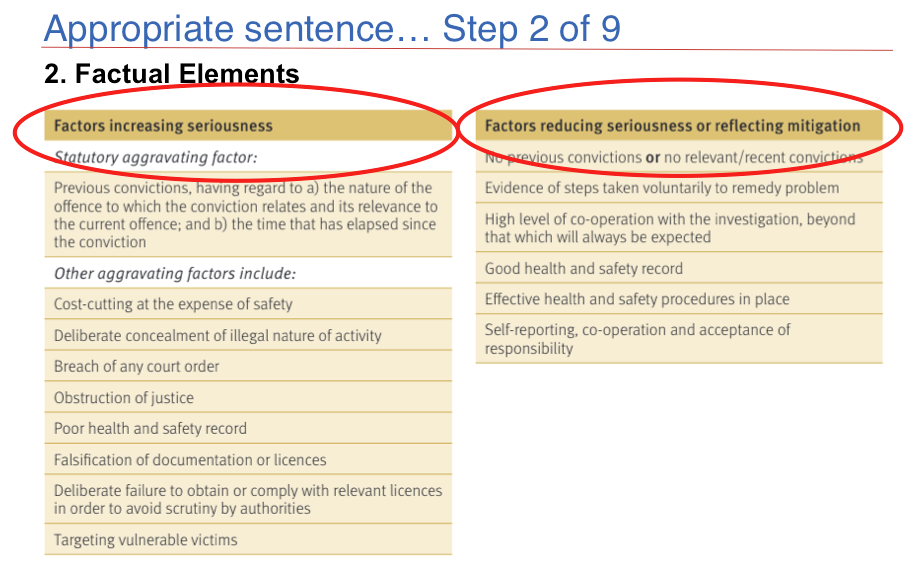
Source (Sentencing Council): https://www.sentencingcouncil.org.uk/wp-content/uploads/HS-offences-definitive-guideline-FINAL-web.pdf
Also, the Health and Safety Executive (HSE)’s view of ISO 45001 is:
HSE inspectors will continue to rely on a wide range of evidence and observations when assessing an organisation’s compliance with health and safety law, not just whether they claim to meet the ISO 45001 standard or not.
Source (HSE): http://www.hse.gov.uk/managing/iso45001.htm
In other words, if there was an incident in your company and the HSE arrived to complete an inspection and assessment, they will not close out the case because you have ISO 45001 certification or any other accreditation, what they want to see, is the evidence you’ve done So Far As Is Reasonably Practicable to prevent harm.
Why would these H&S professionals not agree with the evidence in black and white?
When leaving the meeting, a fellow IOSH member shook my hand and said that I had emboldened him to speak out, he then went on to say…
“There are too many people thinking they need to add more, write more standards… when will these people realise, they just need to do what the law asks?”
To sum up, I was very disappointed but not that surprised to see my fellow IOSH members and other professionals in the room not fully understanding their responsibilities for delivering health and safety in accordance with current legislation.
This, along with my new friend’s statement, prompted me to look into the larger organisation prosecutions since the introduction of the sentencing guidelines in February 2016. My short research found that every one of the 20 large blue chip companies prosecuted I researched, had an IOSH, NEBOSH and or a Level 5 City & Guilds Diploma health and safety professional delivering OHS in the organisation.
It’s just like my friend said: People just need to follow the law, not put all their effort into following standards. They won’t protect you from prosecution.
I would love to hear what you think on this matter, even if you totally disagree with me, please let me know your thoughts.
Email me at: kspencer@yoursafetypal.com
Karl Spencer
Don't take our word for it,
we'll show you how...
Keeps Employees Safe
By providing training, managing and feedback systems that can be evidenced in 27 languages.
Reduces Risk of Accidents
Provides proof, to reduce your exposure to prosecution.
Provides Real-Time Reporting 24/7
Showing what has been completed, and what important tasks need to be done next.